
my Blog ...
Thoughts, insights and real client lived experiences. Check out my various blog articles to learn more about Accelerated Value Creation and Exit and/or Succession Planning.
My goal is to help Mortgage Broking business owners accelerate value creation, whilst concurrently living the life they desire, and always with life in the future front of mind.
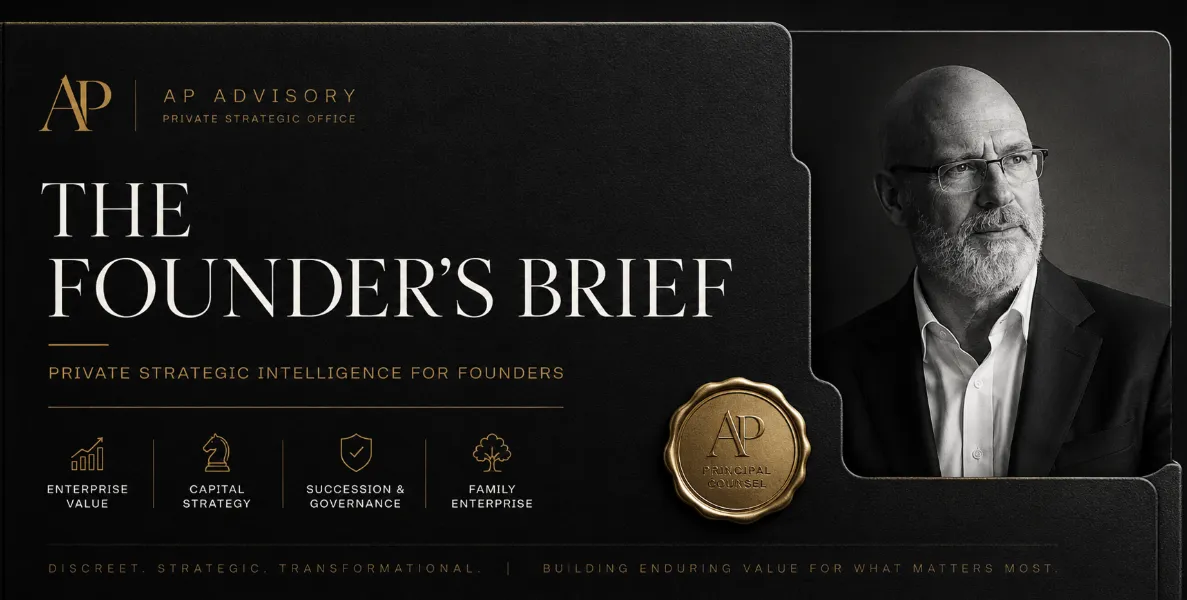
Your Culture Isn't a Soft Asset. It's One of the Most Valuable Assets You Own.
By Ash Playsted
Principal Advisor, AP Advisor
THE FOUNDERS BRIEF
Edition 5
Most founders can tell you exactly what their business is worth.
They know revenue.
They know profit.
They know settlement volumes.
They know EBITDA.
They know their trail book.
But ask them what their culture is worth...
...and the room usually goes quiet.
That's because culture is still treated as something intangible. Something "nice to have." Something delegated to HR, leadership retreats, or employee engagement surveys.
I think that's a mistake.
Culture isn't a soft asset.
It's one of the hardest enterprise assets you'll ever build.
And one of the easiest to lose.
Every Successful Brokerage Has an Invisible Asset
Spend enough time inside high-performing mortgage brokerages and you'll notice something.
The businesses don't just operate differently.
They think differently.
They serve clients differently.
They hire differently.
They make decisions differently.
Their people behave differently.
That isn't an accident.
It's culture.
More specifically, it's the founder's culture.
Every successful founder leaves fingerprints on their business.
Their standards.
Their values.
Their beliefs.
Their way of solving problems.
Their approach to clients.
Their expectations of excellence.
Over time those behaviors become "the way we do things around here."
That is culture.
And it may well become the most valuable asset the business owns.
But Here's the Problem...
In many founder-led businesses, the culture doesn't actually belong to the company.
It belongs to the founder.
The founder models it.
The founder reinforces it.
The founder protects it.
The founder corrects it.
The founder lives it.
Remove the founder...
...and the culture slowly begins to disappear.
Not because anyone intended it to.
But because it was never transferred into the institution.
That's not a culture problem.
That's a stewardship problem.
Sophisticated Founders Don't Build Businesses.
They Build Institutions.
One of the great transitions every founder must eventually make is moving from being the source of the culture...
...to becoming the steward of the culture.
Those are very different roles.
A founder can personally inspire twenty people.
An institution can inspire thousands.
The difference lies in whether the culture has been intentionally embedded into leadership, governance, recruitment, decision-making, accountability, customer experience, and everyday behaviors.
If those things depend upon one individual...
they're not part of the business.
They're part of the founder.
This Matters More Than Most Founders Realize
Private equity firms know it.
Family offices know it.
Institutional investors know it.
When sophisticated buyers assess a business, they aren't simply evaluating financial performance.
They're asking much deeper questions.
What happens when the founder steps back?
Will the leadership team make the same decisions?
Will clients receive the same experience?
Will the standards survive?
Will the next generation protect what made this business exceptional?
These questions are rarely answered in the financial statements.
Yet they often determine whether value is preserved or quietly destroyed after a transaction.
Stewardship Is the Transfer of Culture
At AP Advisory, we believe stewardship is far more than preparing for succession.
It is the disciplined process of ensuring that what made the founder successful becomes permanently embedded inside the enterprise.
That means documenting principles instead of relying on personality.
Building leaders instead of followers.
Creating governance instead of dependence.
Designing systems that reinforce values without requiring the founder's constant presence.
The founder should eventually become the guardian of the culture...
...not its only source.
A Question Every Founder Should Ask
If you took six months away from your business...
Would your culture become stronger...
or would it slowly begin to fade?
The answer probably tells you more about the long-term value of your business than this month's profit and loss statement ever will.
Because enterprise value isn't ultimately protected by financial performance alone.
It's protected by the culture that sustains that performance long after the founder has stepped away.
That is stewardship.
And in the end, stewardship is what transforms a successful business into an enduring institution.
Ash Playsted
Principal Advisor
AP Advisory | Private Strategic Office
"Founder Stewardship is the disciplined responsibility of protecting, strengthening, and preparing an enterprise so it creates enduring value for future owners, employees, customers, families, and communities."


PHONE NUMBER
ADDRESS
L2 / 696 Bourke St., Melbourne, Aust.
L2 / 696 Bourke St., Melbourne, Aust.
WEBSITE