
my Blog ...
Thoughts, insights and real client lived experiences. Check out my various blog articles to learn more about Accelerated Value Creation and Exit and/or Succession Planning.
My goal is to help Mortgage Broking business owners accelerate value creation, whilst concurrently living the life they desire, and always with life in the future front of mind.
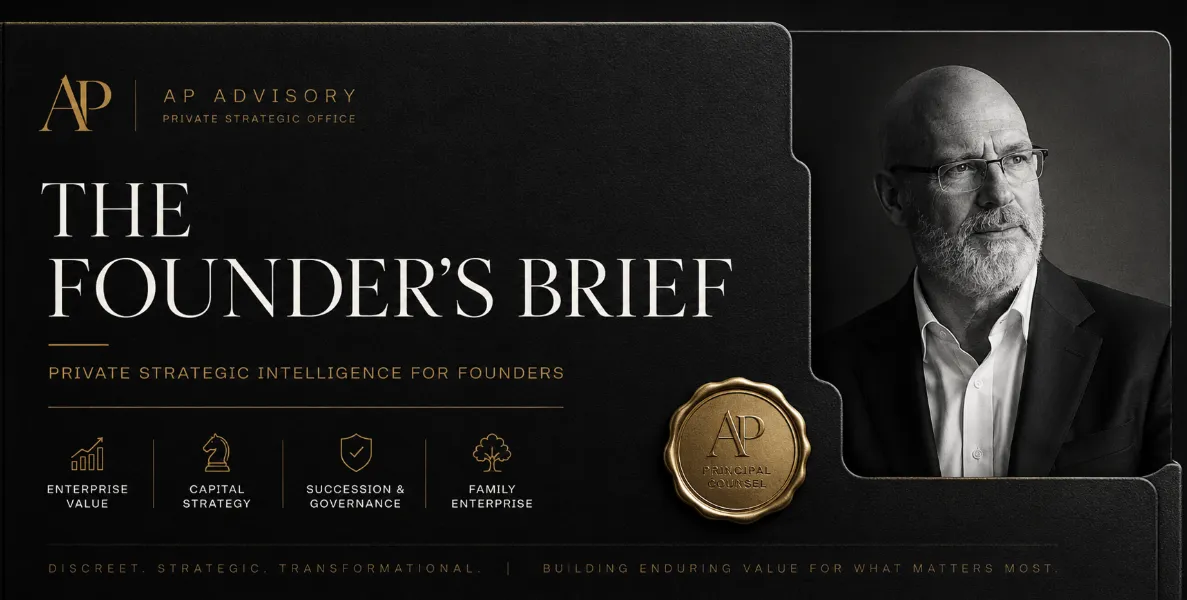
The Founder Wealth Trap
By Ash Playsted
Principal Advisor, AP Advisor
THE FOUNDERS BRIEF
Edition 7
Why so many successful mortgage brokerage founders become wealthy... but not financially free.
There is a conversation I have with successful founders so often that I can almost predict how it will unfold.
The founder is usually somewhere between forty-five and sixty years old. They have spent the better part of two decades building an outstanding brokerage. The business is profitable. Settlements continue to grow. The trail book has become a substantial annuity asset. Their team is capable, clients are loyal, and from the outside they appear to have achieved exactly what they set out to accomplish.
Yet somewhere during our conversation they lean back in their chair and quietly admit something that often surprises me.
"Ash, I know I'm worth several million dollars on paper... but it doesn't actually feel like it."
That single observation reveals one of the least discussed challenges facing successful founders, not only within mortgage broking but across professional services more broadly. It is a challenge I have seen countless times throughout my career, and one I believe will become increasingly important as our industry continues to mature.
The reality is that many founders have become exceptionally successful at creating enterprise value while simultaneously becoming remarkably poor at creating personal liquidity.
Those two things are not the same.
When most people start a business, they are not thinking about enterprise value or succession planning. They are simply trying to replace an income.
For many mortgage brokers, the original ambition is refreshingly simple. They want greater control over their time, a better income than employment can provide, and enough financial security to give their family choices they did not previously have.
Many founders achieve exactly that.
Their income grows well beyond what they ever imagined earning as an employee. They purchase a family home, invest in property, contribute to superannuation, and create a lifestyle that reflects years of hard work and personal sacrifice. By almost every conventional measure, they have succeeded.
The interesting part comes next.
Because while the founder's lifestyle improves, the business often grows much faster than their personal balance sheet.
Year after year, the trail book expands. Revenue compounds. Profitability improves. Enterprise value quietly accumulates in the background. Before long, the founder owns an asset that may be worth several million dollars, sometimes considerably more.
Yet almost none of that wealth is accessible.
It exists almost entirely inside the business itself.
The founder has become wealthier every year while simultaneously becoming less liquid.
This is the founder wealth trap.
It is not a lack of success. Quite the opposite.
The trap exists because success creates concentration.
Over time, the business becomes the family's largest investment. It produces most of the household income. It represents the overwhelming majority of personal net worth. It ultimately becomes the retirement plan, the inheritance plan, and the family's largest financial asset all at once.
If an investment adviser recommended placing eighty or ninety percent of your wealth into a single investment, most people would immediately recognize the risk.
Yet this is precisely the position many successful founders find themselves in.
Their wealth is concentrated inside the one asset they can neither diversify nor easily access.
Ironically, many mortgage brokers spend their careers helping clients build diversified investment portfolios while never addressing the greatest concentration risk in their own financial lives.
What fascinates me is that very few founders actually want to sell.
This is perhaps the biggest misconception surrounding succession planning.
The majority of successful founders I work with still enjoy running their businesses. They enjoy mentoring younger brokers, developing leaders, solving complex lending problems, and continuing to build something meaningful. They are not searching for retirement.
They are searching for flexibility.
The conversation is rarely about wanting to leave.
It is almost always about wanting options.
They begin asking questions that are fundamentally different from those they asked earlier in their entrepreneurial journey.
"Is there a way to realize some of the value I've created without walking away?"
"Can I reduce my personal financial risk while continuing to grow the business?"
"How do I take some chips off the table without ending the game?"
These are sophisticated questions, and unfortunately our industry has not traditionally provided sophisticated answers.
For decades the advice has generally been binary.
Keep building.
Or sell.
Very little attention has been given to the vast strategic landscape that exists between those two extremes.
I believe this is where founder optionality becomes one of the most important strategic concepts of all.
Optionality has very little to do with exiting.
It has everything to do with creating choices.
A founder who has created liquidity outside the business makes fundamentally different decisions from a founder whose entire financial future depends upon extracting every possible dollar from one eventual transaction.
Liquidity changes behavior.
It reduces pressure.
It creates confidence.
It allows founders to think longer term because their family's financial security is no longer entirely dependent upon one asset performing perfectly for another decade.
Perhaps they reduce debt.
Perhaps they diversify into property or private investments.
Perhaps they establish family capital that sits completely outside the operating business.
Perhaps they fund new ventures, philanthropy, or intergenerational wealth planning.
Whatever path they choose, one thing becomes immediately apparent.
Their business is no longer carrying the full weight of every financial objective they have.
This is also why I believe the Australian mortgage broking industry is entering a fascinating new chapter.
The first generation of founders proved they could build exceptional businesses.
The next generation will prove they can build enduring institutions.
Those are two very different disciplines.
Institution building requires founders to think beyond annual settlements and profitability. It requires them to think about governance, ownership structures, leadership succession, capital allocation, enterprise resilience, and ultimately the stewardship of the asset they have spent decades creating.
Most importantly, it requires founders to think differently about capital itself.
Not as something that only appears on the day the business is sold, but as something that can be managed strategically throughout the life of the enterprise.
That shift in thinking has profound implications, not only for founders themselves but for the future structure of our industry.
After more than four decades in mortgage broking, I have become convinced that one of the greatest responsibilities of strategic founder counsel is helping business owners recognize that the objective was never simply to build a valuable business.
The objective is to build a life that offers choice.
Enterprise value certainly matters.
Growth matters.
Profitability matters.
But if every dollar of wealth remains trapped inside the business, the founder has created success without flexibility.
In my experience, the founders who ultimately enjoy the greatest long-term satisfaction are not necessarily those who build the biggest businesses.
They are the ones who deliberately create optionality. They progressively strengthen both the enterprise and their personal balance sheet. They recognize that liquidity is not the opposite of ambition. It is often what allows ambition to continue for another decade.
Perhaps that is the real evolution of founder success.
Not building a business you are forced to sell.
But building one that gives you the freedom to decide what comes next.
Ash Playsted
Principal Advisor
AP Advisory | Private Strategic Office
"Founder optionality begins the moment your wealth starts working for you, instead of remaining trapped inside the business that created it."


PHONE NUMBER
ADDRESS
L2 / 696 Bourke St., Melbourne, Aust.
L2 / 696 Bourke St., Melbourne, Aust.
WEBSITE