
my Blog ...
Thoughts, insights and real client lived experiences. Check out my various blog articles to learn more about Accelerated Value Creation and Exit and/or Succession Planning.
My goal is to help Mortgage Broking business owners accelerate value creation, whilst concurrently living the life they desire, and always with life in the future front of mind.
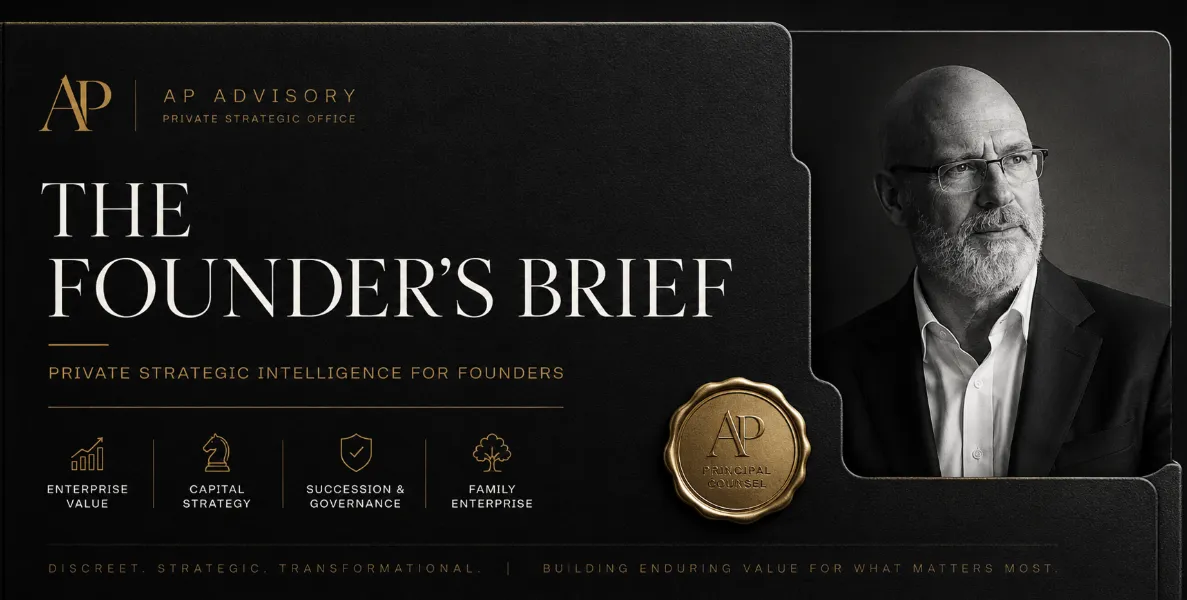
When a Nation Stops Rewarding Risk
By Ash Playsted
Principal Advisor, AP Advisor
There is a phrase I have heard repeatedly throughout my career.
"If I can just get through the next few years."
The founder saying he/she is usually exhausted.
Not defeated. Just tired.
They have spent decades building something from nothing.
They have survived recessions, interest rate cycles, regulatory changes, staff departures, competitor attacks, family sacrifices, and countless sleepless nights.
For many of them, the finish line is finally appearing on the horizon.
Not because they want to stop working.
But because they have reached the stage where they want to begin converting years of effort into freedom, security, and legacy.
The challenge is that many founders now find themselves confronting a reality they never anticipated. The rules appear to be changing just as they arrive at the point where those rules matter most.
Over recent weeks, debate surrounding the Federal Government's proposed capital gains tax reforms has erupted across boardrooms, advisory firms, family offices, investor groups, and LinkedIn feeds.
Predictably, the discussion has become political.
I believe that is a mistake.
Because the real issue isn't politics. The real issue is incentives. And incentives determine behavior. Behavior determines investment. Investment determines economic growth. Economic growth determines prosperity.
Every successful economy in history has understood this relationship.
The question Australia must now answer is whether we still do.
The Difference Between Income and Risk
One of the greatest misunderstandings in public policy is the tendency to treat all forms of income as though they are created equally.
They are not.
The salary earned by an employee and the capital gain generated by a founder represent fundamentally different economic activities.
The employee exchanges time for money. The founder exchanges uncertainty for possibility.
One receives compensation immediately. The other may wait decades.
One faces relatively predictable outcomes. The other risks complete failure.
Most businesses never reach meaningful scale. Many never survive.
Yet the public conversation often assumes successful founders simply arrive at wealth. As though wealth appears naturally. As though successful businesses somehow emerge without sacrifice.
The reality is very different.
Every thriving business was once a fragile idea. Every successful founder once sat alone wondering whether payroll could be met. Every enterprise that eventually creates jobs, taxes, innovation, and opportunity began as a risk.
The critical question therefore becomes simple.
How much should society reward that risk?
Not because founders deserve special treatment, but because society benefits enormously when people are willing to take entrepreneurial risks.
That distinction matters.
Because once the reward for risk begins to shrink, behavior changes.
And when behavior changes, economic outcomes follow.
The Succession Wave Nobody Is Discussing
At AP Advisory, succession planning sits at the center of many conversations.
What most Australians do not realize is that we are approaching one of the largest business ownership transitions in our nation's history.
Across mortgage broking, accounting, legal services, manufacturing, construction, healthcare, financial advice, agriculture, and professional services, an enormous generation of founders is approaching retirement.
These businesses collectively employ hundreds of thousands of Australians.
Many generate millions of dollars in annual revenue.
Many have been operating for decades.
Yet a surprising number are unprepared for transition.
For years, founders assumed they would simply continue growing until the time felt right.
Today, uncertainty is changing that equation.
Instead of discussing growth plans, many are discussing contingency plans. Instead of asking how to build enterprise value, they are asking how to preserve it. Instead of planning ten years ahead, they are reacting to today's headlines.
That shift concerns me because uncertainty is often more damaging than the policy itself. When founders become uncertain, investment slows. Expansion plans pause. Acquisitions get delayed. Hiring decisions get deferred.
The economy rarely suffers from one catastrophic event. More often, it suffers from millions of small decisions made by cautious people.
The View From the Founder Community
The most revealing aspect of this debate is not the proposed tax changes themselves.
It is what founders are saying privately.
I have heard conversations that would have been almost unimaginable five years ago.
Founders asking whether they should sell earlier than planned.
Business owners questioning whether future investment should occur in Australia.
Parents wondering whether their children would be better off building careers overseas.
Investors comparing Australia with competing jurisdictions.
Entrepreneurs considering where they will build their next venture.
This is not because founders are unwilling to contribute.
Most successful business owners already contribute enormously.
Through employment.
Through investment.
Through taxation.
Through community leadership.
The concern is whether the balance between risk and reward remains attractive enough to justify continuing to take entrepreneurial risks.
History suggests this balance matters enormously.
Capital is mobile.
Talent is mobile.
Knowledge is mobile.
Opportunity is mobile.
The countries that attract these resources tend to prosper.
The countries that repel them eventually discover that economic growth is harder to generate than political rhetoric.
The Dangerous Myth of the Wealthy Founder
One narrative regularly appears whenever discussions about capital gains emerge.
The assumption that anyone benefiting from capital appreciation is already wealthy.
Sometimes that is true. Often it is not.
Many founders spend decades effectively reinvesting their future.
Their wealth exists largely on paper.
The business becomes their retirement plan.
The business becomes their family's financial security.
The business becomes their legacy.
For many founders, the eventual sale of the company represents the first significant liquidity event of their lives.
That distinction is critical because succession planning is ultimately about converting illiquid enterprise value into personal freedom.
When policy uncertainty enters that equation, founders naturally begin reassessing their options.
Not because they are greedy. Because they are rational.
What Happens When Incentives Change?
Every economy operates on incentives.
This is not ideology. It is reality.
If governments want more investment, they create incentives that encourage investment.
If governments want more housing, they create incentives that encourage housing construction.
If governments want more innovation, they create incentives that encourage innovation.
The reverse is equally true.
When incentives weaken, participation declines.
Nobody needs to be forced. Behavior simply adjusts.
That is why I believe the most important question surrounding these proposals has nothing to do with tax rates.
The more important question is behavioral.
How many founders delay investment?
How many investors redirect capital?
How many businesses postpone hiring?
How many entrepreneurs decide the next venture is not worth the effort?
Treasury models may estimate revenue outcomes but they are far less effective at measuring lost ambition.
Yet lost ambition may be the most expensive consequence of all.
The Founder's Response
Regardless of how these proposals evolve, founders should treat this moment as a wake-up call.
The era of casual succession planning is ending.
The founders who will thrive over the next decade are not necessarily those with the largest businesses.
They will be those with the greatest strategic clarity.
That means understanding enterprise value. It means understanding ownership structures. It means understanding succession pathways. It means understanding liquidity options.
Most importantly, it means understanding that business strategy and succession strategy are no longer separate disciplines. They are becoming one and the same.
The businesses attracting premium valuations today are not simply profitable. They are transferable. They possess leadership depth. They have governance structures. They have recurring revenue. They have systems that survive beyond the founder.
In other words, they are built for succession.
And businesses built for succession are generally businesses built for value.
Why This Matters Beyond Founders
Some readers may wonder why ordinary Australians should care about founder succession.
The answer is straightforward.
Because founders create the environments within which prosperity occurs.
They create jobs. They create innovation. They create opportunity. They create tax revenue. They create community wealth.
When founder confidence weakens, the consequences extend far beyond business owners.
The impact eventually reaches employees, families, communities, and future generations.
A country does not become prosperous by accident. It becomes prosperous because enough people are willing to take risks.
Enough people are willing to invest and enough people are willing to build.
The challenge facing Australia today is ensuring those people continue to believe the reward remains worth the risk.
A Defining Moment
I suspect history will view this period as more significant than many currently realize.
Not necessarily because of a specific tax proposal.
But because of the broader questions it forces us to confront.
What kind of economy do we want to build?
What kind of entrepreneurial culture do we want to encourage?
What signals are we sending to those considering taking risks?
What signals are we sending to those already carrying them?
For decades, Australia has benefited from a strong culture of enterprise.
Small business owners, founders, investors, and entrepreneurs have helped create one of the most prosperous societies on earth.
That success should never be taken for granted.
Because prosperity is not self-sustaining. It must be continually renewed by each generation willing to build.
___________________________________________________________________________
As I write this, many founders across Australia are reviewing their plans.
Some are accelerating succession conversations. Some are reassessing investment decisions.
Some are wondering whether the future they envisioned still exists.
My advice remains unchanged.
Do not panic, and do not react emotionally. But do not ignore what is happening either.
Understand your value. Understand your options. Build a business capable of thriving regardless of policy changes. And remember that the greatest form of resilience has always been optionality.
Governments may change rules.
Markets may change direction.
Economic cycles may come and go.
But founders who build valuable, transferable businesses retain choices.
In uncertain times, those choices become extraordinarily valuable.
The debate surrounding capital gains tax is ultimately not about tax.
It is about whether Australia continues to reward those willing to take risks, build enterprises, create jobs, and invest in the future.
That is not a political question.
It is a national one.
And every founder should be paying attention.


PHONE NUMBER
ADDRESS
L2 / 696 Bourke St., Melbourne, Aust.
L2 / 696 Bourke St., Melbourne, Aust.
WEBSITE